
Cultural Gems of Madhya Pradesh 02 Gwalior, 02 Khajuraho & 01 Orchha


About Description
The regal city of Gwalior, home to majestic forts and rich musical legacy. Explore the world-renowned temples of Khajuraho, a UNESCO World Heritage Site, celebrated for their intricate carvings and spiritual significance. End your journey in the charming riverside town of Orchha, filled with palaces, cenotaphs, and Mughal-Rajput architecture.
Inclusion
- Accommodation at all places on twin sharing basis
- Meal as per mentioned with Hotels
- All transfers and excursions as per itinerary by respective car as mentioned above
Exclusion
- SUPPLEMENT COST: (SUBJECT TO AVAILABILITY)
- Guide Can be provided at Gwalior, Morena, Orccha and Khajuraho at extra cost (Up to 6 Person)
- Gwalior Guide Cost Rs. 3500
- Morena Guide Cost Rs. 4500
- Orccha Guide Cost Rs. 3500
- Khajuraho Guide Cost Rs. 3500
- Air Fare/Train Fare & all entry fees at sightseeing spots
- Items of personal nature like portage, tips, laundry, telephone calls, mineral water etc.
- Optional Activities mentioned in the itinerary
- GST 5% Over and above on Main Prices & optional services.
- Expenses caused by factors beyond our control like rail and flight delays, roadblocks, vehicle mal-functions, political disturbances etc.
- Entrance fees to monuments and museum
- All personal expenses
- Anything not mentioned in the inclusions list
- All domestic and international flights, other meals, tips, drinks, international airport tax, single room supplements, peak season surcharges, personal expenses, travel insurance, visas, any optional additional tours or activities during free time, early check in/late check- out at your hotel, Covid tets and anything related to covid
- Lunch/dinner at hotels
- Room service
- Telephone calls and laundry
- Any portage at airports and hotels, tips, insurance, wine ,mineral water, telephone charges, guide charges, boating charges, entrance fees and all items of personal nature
- Any service not specified in inclusions
- 5 % GST
Payment Policy
- 100 % Advance 15 Days Before Departur
Cancellation Policy
- 100 % Applicable 15 days before departure
Terms & Conditions
- This package valid for minimum 2 Pax travelling together.
- We don’t hold any hotel rooms at this time.
- The price will not be applicable for peak season.
- We offer above hotels /or same similar class another hotels upon availability.
Itinerary
Day 1
Arrive Gwalior

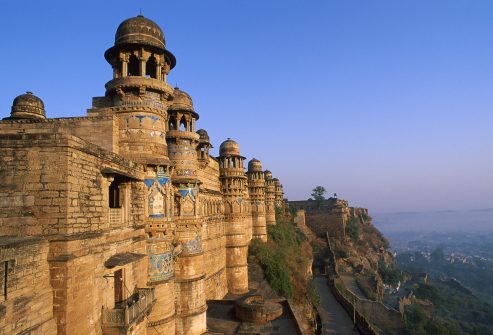
- Pick up from Gwalior Airport/Railway Station and transfer to the Hotel. Check in to the Hotel. Later Proceed to visit Gwalior fort, Tansen Ka Makbara and Sun Temple. Overnight stay at the Gwalior hotel.
- Gawalior Fort has existed at least since the 10th century, and the inscriptions and monuments found within what is now the fort campus indicate that it may have existed as early as the beginning of the 6th century. The present-day fort consists of a defensive structure and two main palaces, “”Man Mandir”” and Gujari Mahal, built by Tomar Rajput ruler Man Singh Tomar (reigned 1486–1516 CE), the latter one for his wife, Queen Mrignayani. The second oldest record of “”zero”” in the world was found in a small temple (the stone inscription has the second oldest record of the numeric zero symbol having a place value as in the modern decimal notation. There are also a number of Mahal including the Man mandir, the Gujari, the Jahangir, the Karan, and the Shah Jahan.
- Jai Vilas Palace was built in 1874 by Jayajirao Scindia, the Maharaja of Gwalior in the British Raj While the major part of the palace is now the “Jiwajirao Scindia Museum” which opened to the public in 1964, a part of it is still the residence of some of his descendants. Jai Vilas Palace is a fine example of European architecture. It was designed and built by Sir Michael Filose. It is a combination of architectural styles, the first storey is Tuscan, the second Italian-Doric and the third Corinthian. The area of the Palace is 124,771 square feet and it is known for its large Durbar Hall. The interior of the Durbar Hall is decorated with gilt and gold furnishings and adorned with a huge carpet and gigantic chandeliers. It is 100 feet long, 50 feet wide and 41 feet in height.The palace was described by Sir William Howard Russell in 1877.
Day 2
Gwalior – Morena (02 Hrs one way Drive)
- After breakfast, proceed to visit Jai vilas palace Museum. Later transfer to Morena. Visit Mitawali, Padawali and Bateshwar. Later back to Gwalior. Night stay in Gwalior.
Jai Vilas Palace was built in 1874 by Jayajirao Scindia, the Maharaja of Gwalior in the British Raj While the major part of the palace is now the “Jiwajirao Scindia Museum” which opened to the public in 1964, a part of it is still the residence of some of his descendants. Jai Vilas Palace is a fine example of European architecture. It was designed and built by Sir Michael Filose. It is a combination of architectural styles, the first storey is Tuscan, the second Italian-Doric and the third Corinthian. The area of the Palace is 124,771 square feet and it is known for its large Durbar Hall. The interior of the Durbar Hall is decorated with gilt and gold furnishings and adorned with a huge carpet and gigantic chandeliers. It is 100 feet long, 50 feet wide and 41 feet in height.The palace was described by Sir William Howard Russell in 1877.
Mitawali, Padavali and Bateshwar are the beautiful set of heritage structures dating back to the 8th-10th century, during the Gurjara-Pratihara dynasties. - Mitawali: It has lies the historical for Chausath Yogini Temple. The temple is also known as Ekattarso Mahadeva Temple. It is believed that the temple was built by the Kachchhapaghata king Devapala in the 11th century. The temple looks like the Parliament House of Delhi as both are circular in style. It is said that this temple was the inspiration behind the Parliament House.
- Padawali: The Jat Ranas of Dhaulpur built the Padawali fort in the 18th century. The fort also has a temple that once served as a divine place to worship Lord Shiva. Through inscription and detailing of the architecture of the Padavali fort temple, it has something to convey about the ancient era.
- Bateshwar: It is a group of about 200 Hindu temples made of sandstone. The temples were built by the Gurjara kings in the Morena district of Madhya Pradesh between the 8th to 10th centuries. All the temples are mostly small and are spread over 25 acres of land. Temples are dedicated to Shiva, Vishnu, and Shakti – representing the three major traditions within Hinduism.
Day 3
Gwalior – Datia (1.5 Hrs.) – Jhansi (30 Min) - Khajuraho (03 Hrs.)
- Morning transfer to Khajuraho.
- En-route visit Datia Palace at Datia.
- En-route visit Jhansi Fort at Jhansi
- Later Hotel check in to the Khajuraho Hotel and relax. Night stay at Khajuraho.
- Datia Palace, also known as Bir Singh Palace or Bir Singh Dev Palace. The specialty of the palace is that it has 7 floors and no member of the royal family lived in the palace.This Palace was made by spending 35 Lakh Rupees (78 thousand US dollars), and it took nine years to build it. It is situated on an isolated rock on the western side of the city Datia. It represents Mughal architecture along with Rajput architecture.
- Jhansi Fort The construction of the Jhansi fort is ascribed to the Bundela Rajput chief and the ruler of the kingdom of Orchha Veer Singh ju Deo Bundela in 1613. It is one of the strongholds of the Bundelas. The fort standing in the hilly area shows how the North Indian style of fort construction differs from that of the South. In the South, most of the forts were built on the sea beds like the Bekal Fort in Kerala. The granite walls of the fort are between 16 and 20 feet thick and on the south side, the city walls meet. The south face of the fort is almost perpendicular. Nearby is the Rani Mahal, built in the later half of the 19th century where there is now an archaeological museum
- Raneh Fall: The Ken Gharial Sanctuary is located at the confluence of the Ken and Khudar rivers further down from Reneh Falls. The Ken river here runs through a narrow gorge of igneous rocks rich in Granite and Dolomite.
Day 4
Khajuraho Sightseeing
Early breakfast and Proceed to visit The Western and Eastern groups of Temple (UNESCO World Heritage Site). Laster visit Raneh fall and Ken Gariyal century. Overnight stay at Khajuraho Hotel.
Day 5
Khajuraho - Orchha Sightseeing (03 Hrs.)
- After Breakfast, Checkout and proceed to Orchha. Check in to the Hotel. Later proceed to visit Orchha Fort – Jahangir Mahal, Raja Mahal, Sheesh mahal and Ram Raja Mandir. Evening Visit Light and Sound Show Orchha Fort. Night stay in Orchha.
- The Orchha Fort or The Orchha Fort complex, which houses a large number of ancient monuments consisting of the fort, palaces, temple, and other edifices. The fort was built following the founding of the Orchha State in 1501 AD by Rudra Pratap Singh (r. 1501–1531), a Bundela Rajput. The palaces and temples within the fort complex were built over a period of time by successive Maharajas of the Orchha State.
- Jahangir Mahal: Jahangir Mahal is a palace that was exclusively built by Bir
- Singh Deo in 1605 to humor the Mughal emperor Jahangir who was a guest of the Maharaja for one night only. The palace is built in four levels with architectural features of both Muslim and Rajput architecture. Its layout is a symmetrical square, built in the inner courtyard of the fort, and has eight large domes. It provides views of the temples and the Betwa River outside the fort complex.”
- Raja Mahal: The Raja Mahal (King’s Palace), where the kings and the queens had resided till it was abandoned in 1783,[6] was built in the early part of 16th century. Its exterior is simple and unembellished, but the interior chambers of the palace are elaborately royal in their architectural design, decorated with murals of social and religious themes of gods, mythical animals, and people.
- Sheesh Mahal: Sheesh Mahal is flanked on either side by the Raja Mahal and the Jahangir
Mahal. This has royal accommodation, which was built for King Udait Singh. It has now been converted into a hotel. - Ram Raja Temple: A part of Raja Mahal was converted into a temple and named Rama Raja Temple in honour of the god Rama. There is legend associated with naming it as a temple. According to a local legend, the temple was built following Rani Ganeshkuwari, the queen getting a “”dream visitation”” by Lord Rama directing her to build a temple for Him; while Madhukar Shah was a devotee of Krishna, his wife’s dedication was to Rama. Following this, a new temple known as the Chaturbuj Temple was approved to be built, and the queen went to Ayodhya to obtain an image of Lord Rama that was to be enshrined in her new temple. In India this is the only temple where God Rama is worshiped as a king and that too in a palace. A Guard of Honour is held every day, police personnel have been designated as Guards at the temple, much in the manner of a king. The food and other amenities provided to the deity at the temple are a royal repast. Armed salutation is provided to God Ram every day.
Day 6
Orchha – Gwalior Departure (03 Hrs.)
After breakfast, Checkout and Proceed to Gwalior Airport/Railway Station for your onward journey.